

Can Nature-Based Climate Solutions Support Conservation of Coastal Ecosystems?
SJINML Research Seminar by Dr. Zeng Yiwen
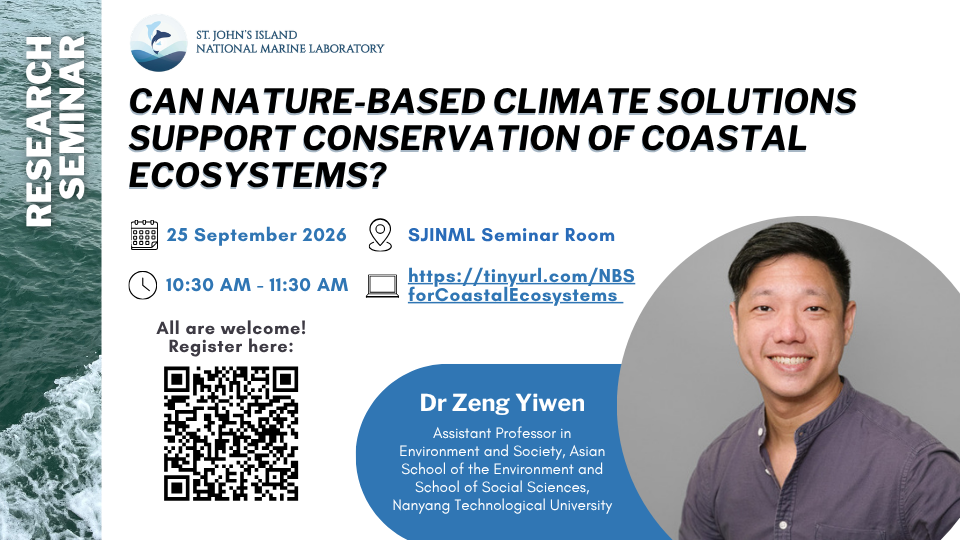
Date: 25 September 2026
Time: 10:30AM - 11:30AM
Location: SJINML Seminar Room
We are delighted to be hosting a talk - "Can nature-based climate solutions support conservation of coastal ecosystems?" by Dr Zeng Yiwen.
Dr. Zeng Yiwen is an Assistant Professor at Nanyang Technological University, Singapore, with a joint appointment between the Asian School of the Environment and the School of Social Sciences. Trained as an applied ecologist and geospatial modeller, his research seeks to understand how conservation and climate policy can be better designed to safeguard biodiversity in a rapidly changing world. As human pressures continue to change and reshape ecosystems, he is particularly interested in how limited conservation resources can be directed towards interventions that deliver the greatest long-term benefits for both nature and people while remaining socially equitable and economically viable.
Talk sypnosis:
Climate change and biodiversity loss are global challenges that we have to address simultaneously. We need to protect, restore and manage ecosystems across terrestrial and coastal environments, delivering climate change mitigation alongside broader ecological benefits. However, the real-world effectiveness of such interventions depends on much more than biophysical potential alone. Here, I will examine when nature-based climate solutions can meaningfully support biodiversity conservation, drawing on research spanning mangroves, carbon markets and coastal ecosystems.
First, I explore the gap between theoretical potential and practical implementation, showing how financial, land-use and operational constraints can substantially reduce achievable climate mitigation. Second, I consider the long-term durability of these interventions, including how socioeconomic pressures, sea-level rise and extreme events can threaten conservation outcomes. Third, I ask whether interventions designed primarily around carbon necessarily deliver conditions necessary for biodiversity conservation. I will conclude by considering cases where poorly designed climate actions, including mangrove afforestation and renewable-energy development on tidal flats, can themselves create biodiversity trade-offs. Together, these stories reveal both the potential and the uncomfortable limits of trying to conserve biodiversity and address climate change simultaneously.
We hope to see you there!